Time For Dessert

dessertI have a killer sweet tooth. Honestly. It’s killer on my waistline. But I was at a wine event a couple of years ago that saved my sweets-lovin’ life.

It was one of those five course meals where every course had a different wine. For dessert, we were served blue cheese, almonds, and tawny port. The sweet course would never be the same for me again.

tawny-portNow that I’ve eschewed pastries for the savory-salty-sweet that a handful of raw almonds and some perfect cheese provide (last night, it was the amazing Boonter’s Blue from Penny Royal Farmstead), the choice of port is important. For the final course of the day to be fully satisfying, you need a dessert wine that will do justice to the craftsmanship of the marbled, aged creation of sheep and goat’s milk. The Graziano Syrah Tawny Port was an exquisite option. The complex, nectarous flavors made me yearn for colder nights spent snuggling by the fire. It was a toothsome treat, and a good way to punctuate a day. Honestly, who needs cake when there are endings such as these?

Salad Days

nectarine saladThere’s just something about the tender-green of baby kale coupled with the sweet tang of nectarines that I’ve been finding extremely satisfying of late. This crisp salad is a mouthful of summer and delicious enough to tempt me away from evening writing projects.

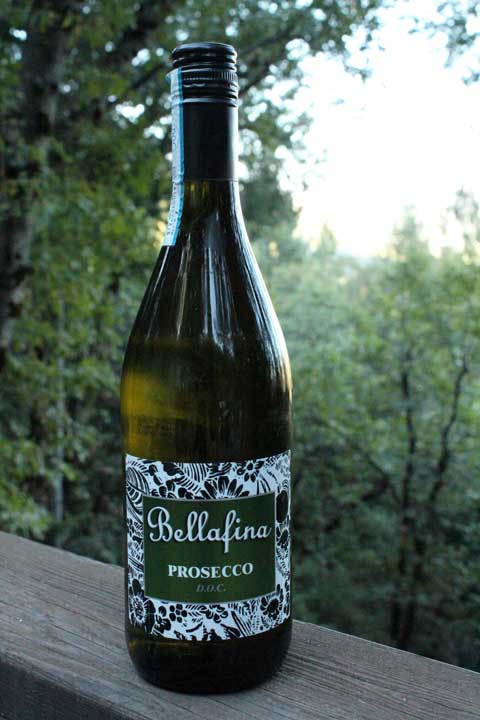
bellafinaDinner arranged, the challenge of pairing was presented — the sparkle of the dish was heightened with a Prosecco, perfect for a balmy twilight.

My choice of the Bellafina Prosecco was a happy accident, an impulse purchase that had then been absentmindedly shoved into the back of the refrigerator. Maybe it was actually kismet, as the flavors of stone fruits, lemon cream, and almonds were harmonious with the varying sweet and lush flavors of the salad. The wine’s orange bitter finish was paradisiacal with the kale. Isn’t it marvelous how good food and great wine always seem to find each other?

Nectarines & Baby Kale Salad

two handfuls of baby kale
1 nectarine, sliced into thin wedges
1/2 avocado, cubed
a sprinkling of tamari pumpkin seeds
a sprinkling of shredded coconut (Leftover, perhaps, from your coconut shrimp?)
drizzle of poppy seed dressing

Toss everything together and serve right away, appreciating the crisp, refreshing qualities of both the salad and the Prosecco.

Smoky Times Call for Smoky Measures

prawnsSmoke. Fumé. Humo. Rauchen. Deatach. Ysmygu. We’re surrounded by smoke in my neck of the woods from two separate fires. It’s all we’ve talked about at work this week. It’s at the forefront of our thoughts, as our lungs won’t allow us to forget.

Since playing with words is one of my pastimes, and wine is my passion, it’s no surprise that the constant swirling of my atmosphere made me think of Fumé Blanc.

Robert Mondavi invented the term for his Sauvignon Blanc styled after the Pouilly-Fumé wine of the Loire Valley. Choosing the new moniker helped to differentiate his drier style from the sweeter Sauvignon Blancs of the late 1960s. And the rest, as you well know, is history.

Those aren't clouds in the background. It's smoke.

Those aren’t clouds in the background. It’s smoke.

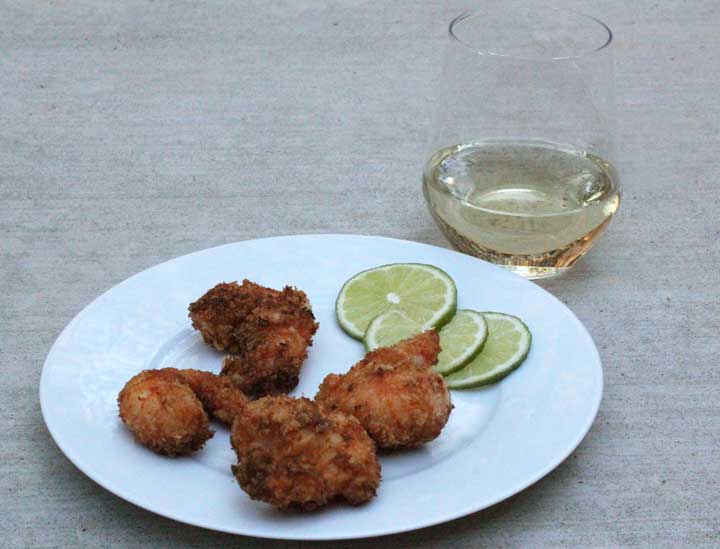
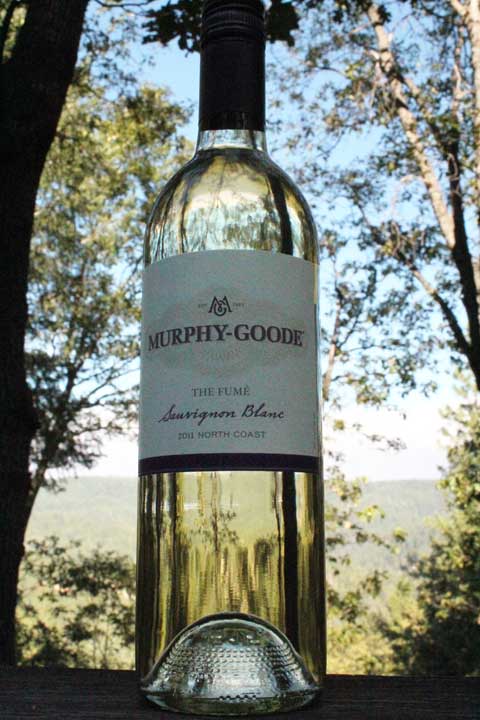
I landed on Murphy-Goode’s The Fumé. It was staring out at me from the shelf in quite an alluring fashion. I then read the label’s pairing suggestions and decided that coconut prawns would be the correct choice of cuisine.

It was a delightful decision. The tropical notes of mango in the wine married nicely to the coconut batter of the prawns. The creaminess of the Fumé went hand-in-hand with the richness of the shrimp, and the sprinkling of lime that the dish received after cooking brought out key lime pie characteristics in the glass. Smoky, silky, with hints of melon — to sum up the wine succinctly, well, it was yummy, and it made for a damn good(e) dinner.

Coconut Prawns

Organic canola oil for frying
1/4 cup Kinnikinnick gluten-free bread crumbs
1/2 teaspoon salt
drizzle of sriracha
1 lime
1 cup shredded coconut
2 egg whites
1 pound prawns, deveined and peeled

Heat two inches of oil over medium high heat.
Combine bread crumbs with coconut and mix thoroughly.
Salt prawns. Add sriracha and mix until coated.
Lightly beat the egg whites. Dip prawns in the egg, coat with the coconut mixture, and drop into the hot oil.
Flip prawns over when the batter has turned a dark, golden brown.
Serve with lime wedges and the ever-so-awesome Murphy-Goode The Fumé.

A Pretty Pairing

fettuccineYou know how sometimes you hit upon a wine and food pairing so good the Heavens open and you can hear the angels serenading? I had one of those pairings last night.

It all started with a gluten-free pasta I’d been introduced to last week. A garlic fettuccine created in an allergen-free environment, it was worth trying. It ended up being well worth trying. I tossed it with butter, sage, and garlic, and it was fantastic. So fantastic, I had to have it again.

fettuccine-ingredientsWith this meal, I wanted to create something bright, fun, and satisfying – the same way you feel when you witness the weekend welcoming you in. The personalities for my plate included Cypress Grove Chevre’s PsycheDillic, raw pistachios, the aforementioned amazing Maninis pasta, a splash of cream, a tablespoon of salted butter, a drizzle of olive oil, and the true star of the show, Kendall-Jackson’s AVANT Chardonnay.

Since the pasta is fresh, the cooking time is only three minutes. While the noodles drained in the colander, I sacrificed a splash of the AVANT, along with the butter and cream, to create a sauce. Whisking quickly to avoid curdling, I cooked it just long enough on low heat for it to thicken slightly. I then tossed the noodles in a bit of olive oil to keep the noodles separated and added them to the sauce. The sauced-up fettuccine was then placed ever-so-lovingly on a plate, sprinkled with Chevre and pistachios and was ready to be served with the delightful glass of Chard.

Here’s where the chorus of Heavenly voices came into play. The green apple qualities of the wine were vibrantly lovely when paired with the bright flavors of goat cheese and dill. The light creaminess of the AVANT complimented the round, nutty flavors of the pistachios, and a truly synergistic dinner was enjoyed.

I have a friend who’s a winemaker in Napa, and she told me once that Chardonnay is the favorite of winemakers, as they get to create exactly the wine they want with the grapes. In Chardonnay, you see the character of its creator. As dinner was cleared and a second glass was enjoyed as my digestif, I appreciated the artistry that went into the AVANT. Crisp and light, it teased the nose with early autumn sunrises, flowed into the glass with pears and green apples and a delicately creamy mouthfeel. It was a beautiful wine to enjoy as the cool breeze tossed the oak trees outside. I savored the final drops as frogs began to sing their evening melody and was grateful for a delicious finale for my Friday.

A Candlelit Flight

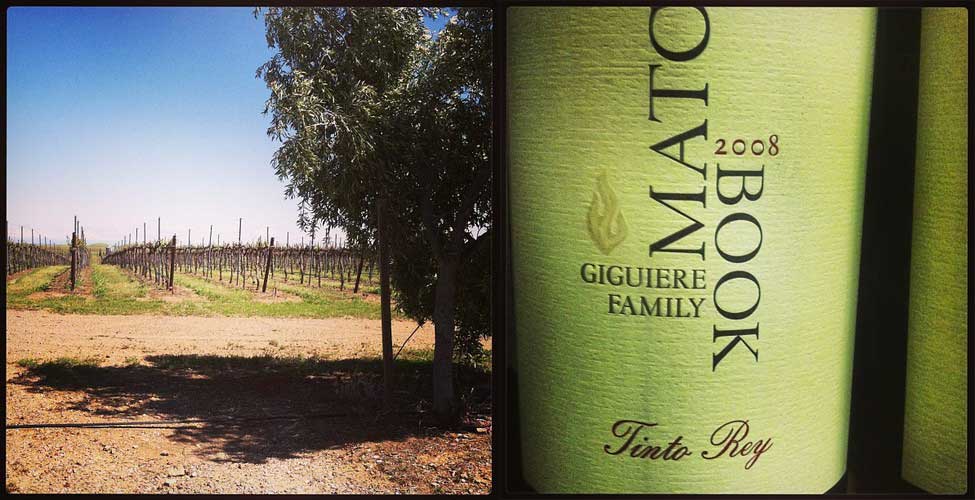
matchbookIt was an incredibly blustery Monday. It was so windy, the power at Matchbook Winery had been blown out as easily as a small flame.

The darkness of the barrel room didn’t detract from the enjoyment of the day. It actually added an alluring ambiance as candlelight danced upon the five wine glasses lined up in front of each participant. We would each get the opportunity to enjoy two flights, exploring the process of how Matchbook’s staff settled on its blend, Tinto Rey.

The winery is nestled in Yolo County’s Dunnigan Hills. The native grasses, lupin, and wild mustard plants that were roiling in the wind that day, tossing like a choppy lake, made their presence known within the wines we sampled. They brought a subtle, unifying characteristic to the juice that was produced just outside of Zamora. Not everything we would sample was from the Dunnigan Hills, but those that were all held the same lovely, delicate flavors of the rolling hills.

The first flight included two Tempranillos, a Syrah, a Graciano, and the base blend derived from a combination of the four. The first Tempranillo had black pepper, spice, and cedar on the nose with chocolate and fruit on the front of the palate. The second Tempranillo, slightly older but also utilizing the native yeasts like the first, had a hint of cocoa and a touch of mint on the nose with a rounder palate that held vanilla and red fruit.

The 2010 Syrah’s nose was of black pepper and white sage. It was robust and structured with flavors of black cherry.

The fourth pour, a 2010 Graciano, had wild mustard, dill, and yeast on the nose with tart cherry, mocha, and a hint of musk nestled in its nice tannins.

The base blend, a combination of 49 percent Tempranillo, 36 percent Syrah, and 15 percent Graciano had chocolate, vanilla bean, and black cherry when sniffed and presented flavors of mocha and blueberry within a wine that had good structure and a nice finish.

Matchbook owner John Giguiere is a fifth generation farmer who started with RH Phillips and Toasted Head. After those successes, he decided to create a winery around the wines he enjoyed and started Matchbook.

“Everything is driven by our agriculture first,” he explained of his process.

Along with grapes, the farm is also growing olive trees and will soon host its own tasting room.

The second flight began with the last glass from the previous flight, the base blend. The winemakers explained that they were looking for ways to “bring it up a notch” and in so doing, brought out their “tool box” wines. They included a 2010 Tannat, the base blend plus Tannat, and a 2012 Cabernet Sauvignon. These would be combined to create the final blend, 49 percent Tempranillo, 27 percent Syrah, 15 percent Graciano, three percent Tannat, and six percent Cabernet Sauvignon.

The Tannat had a lot of tannins, a touch of bret, and leather character. With the base blend and the Tannat married, coffee and black currant presented themselves in the nose while the palate held a nice, chewy wine with red fruit and blueberries. The Cabbie was a fresh bowl of rising bread dough in the nose with nice tannins and a hint of green bell pepper in the glass.

A good bottle of wine results when the left and right hemispheres of the brain work together, creating an experience that utilizes all the senses.

“The art is knowing when not to use the science,” explained the winemaker.

When all of those lovely, though somewhat disconnected, parts were combined in just the right amounts, I was presented with brambleberry and cocoa aromas and a robust glass of red fruit, chocolate, spice, and black tea with wonderful tannins that will be quite the sought-after blend when it’s available in a year and a half’s time.

It was quite a charming day spent surrounded by wine barrels and nice people, everyone so excited by wine and its characteristics – bliss!

Eating Winchester

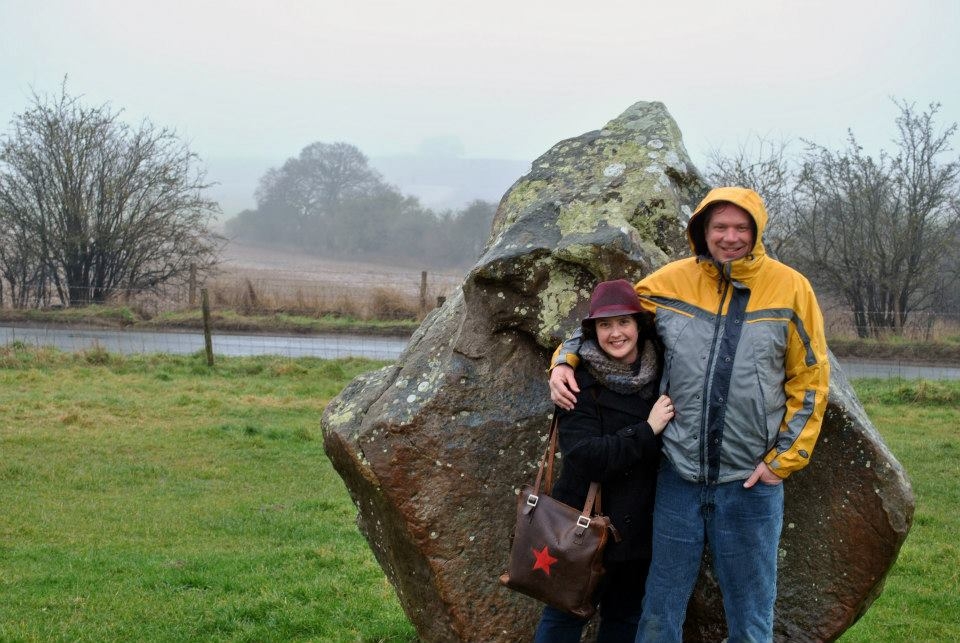
Avebury

The skies were dreary and overcast. My wool pea coat was a must and was destined to be drenched multiple times. A pub and a pint by a crackling fire beckoned, but I was on a gastronomic mission – to eat at as many great restaurants in Winchester as possible.

We were visiting my sister, a recent Masters graduate from the Winchester School of Art. People had made fun of our culinary pursuits while in England – don’t they boil everything? – but we persevered and were rewarded with a week’s worth of wonderful meals. Winchester is actually a hub of a town with a teeming culture.

To begin our eatery extravaganza, we did in fact choose a pub. We were in England after all! At the Royal Oak, I opted for the Fish & Chips, and I was not disappointed. The haddock had wonderful flavor, the batter light and crunchy. The serving was huge – too much to consume in one sitting. The only unfortunate aspect was that it was presented on a wooden tray that had obviously been abused with frequent washing. (I was also not a fan of mushy peas, sorry!)

Trying Indian food was a must. I grew up in Yuba City (it’s often referred to as “Little India” because of the large Sikh population), which means that I also grew up with Indian cuisine, and I was curious to experience the differences – if any – from across the pond. The waiter didn’t believe that I could handle the spice in my meal, I ordered madras, but I could have handled more. We shared some lovely garlic naan and a bottle of Riesling for a very satisfying meal.

At Rimjhim, we waited – and waited – for the bill. We had encountered the lovely, non-pushy restaurant culture in Great Britain. They’ll let you sit there for hours if you don’t tell them you’d like the bill that last time the waiter or waitress stops by and asks if you’d like anything else. (When we ended up wanting dessert at another place after our meal, we had to practically pounce on a member of the staff in order to procure our bill.) After being left alone for what seemed like an eternity, we finally walked up to the register.

With traditional pub food and Indian out of the way, the next stop on our culinary journey was, of course, Italian. Zizzi was a bit haughty, and they sat our riffraff selves in a corner behind a life-sized statue of a horse, but my Ravioli Di Capra was divine, and the Barbera De Asti Superiore 2010 D.O.C.G., Chiarlo Piemonte was quite lovely with the food. It did sport more than a touch of Brett, to which I’m very sensitive (I think it tastes like Band-Aids), so it wasn’t my favorite, though that Brettanomyces, along with its restrained mineral characteristics, made it very European.

On our last day, we kept it Mediterranean and headed to Spain. El Sabio had a wonderful assortment of tapas. My choice of three dishes, Croquetas De Setas y Queso de Cabrales, Ensalada Mixta, and Albóndigas en Salsa de Tomate were perfect and packed with flavor. We shared a bottle of Tempranillo, Marqués de Verdellano for a very easy-going, and very filling, lunch.

I think our favorite stop of all was The Black Bottle – not a restaurant, though they do offer food, but rather a wine bar. With a card that had been charged from money given at the register, you could choose wine by the glass in 125 ml, 175 ml, or taste sizes. I had a grand time skipping around and sampling various wines from the automated dispensers until I happened upon my favorite, Masseria Pietrosa Malvasia Nera, and had a glass. I love it and am hoping to find a distributor here in the States. Thank goodness I live with a wine buyer!

All in all, our gastronomic tour of Winchester was a rousing success. We had a wonderful experience, and with all of the walking we did, I managed not to gain any weight, so, WIN!

Harvesting Sangio

The sun gifts us with the first light of day.

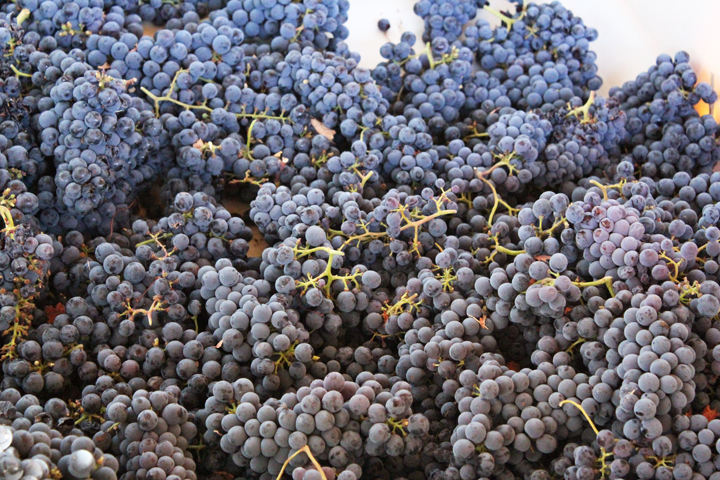
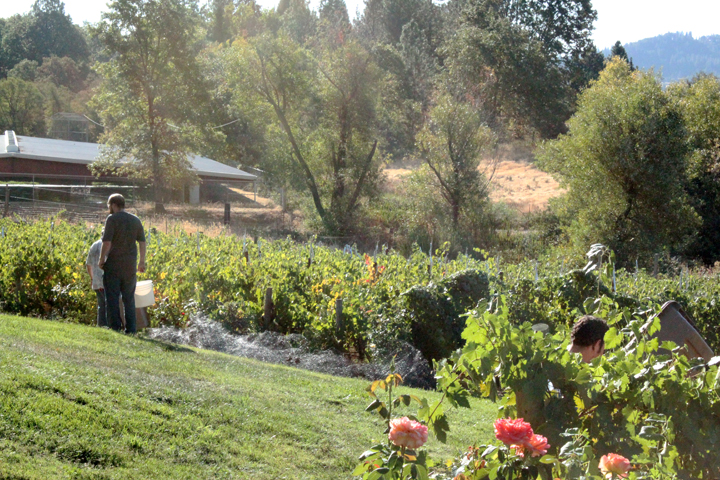
As it climbs higher in the sky, I will experience a slight ache in my back, an amazing sense of satisfaction, and a very minor buzzing in my head – the ache from harvesting grapes grown in the traditional, Italian way (tight rows and low-hanging fruit), the satisfaction from working as hard and as quickly as possible among the vines, and the buzz from the amazing champagne brunch that is our payment for a job well done.

For the past three seasons, my Charles and I have helped in Montoliva’s harvest of its estate-grown Sangiovese grapes. Each year, it’s gotten easier. In part, this is because we’re getting a bit better, but more of the success has come from nicer weather.

The harvest in 2010 was on Halloween. It was cold and stormy. It had rained the night before, so even though I was wearing a sweater underneath my raincoat, I was drenched and shivering within five minutes. 2011 was warmer and more pleasant, though there had been some moisture, so we dealt with a small amount of rot. Plus, I forgot to bring our gloves, so my Charles and I both managed to nick ourselves with our clippers. 2012 was hot and dry. The bunches were big and beautiful and dusty – no moisture, and therefore no rot, to be found.

This year’s crew was also outstanding. For the first time, the entire estate was harvested on the same day, and not only that, it was harvested in a few hours. Everyone kicked some major ass and took some major names. My Charles and I were home by noon, feeling good, though tired, and cheered by a beautiful, warm morning spent out amongst the vines.

2012 is going to be an amazing year for California wines.

Blood Orange Curry Chicken

We have an odd combination when it comes to in-season produce right now. Blood oranges and asparagus are neck and neck in the race for most-local.

This combo was too tempting to pass up — imagine the citrus-sweet flavors with the woody green wonder that is first-of-the-season asparagus. I’m surprised I can hold myself together.

Blood Orange Curry Chicken

1 whole free-range, organic chicken

1 TB curry powder

1 tsp Redmond Season Salt

1 tsp rubbed sage

1/2 tsp cardamom

1/2 tsp nutmeg

1/4 tsp ginger

2 small blood oranges, cut in halves

olive oil

Combine curry, season salt, sage, cardamom, nutmeg, and ginger in a small bowl. Stir. Loosen the skin above the breast meat. Rub olive oil over and inside the chicken. Rub herb mixture inside the loosened skin, then rub inside cavity and over the outside of the bird. Cut oranges in half. Squeeze juice inside the loosened skin, cavity, and outside of bird then place all four halves inside cavity. Bake at 325 degrees for two and a half hours, breast down. Flip chicken for the last hour of cooking. Take chicken out of the oven and rest.

While chicken is resting, cook asparagus.

Sauteed Asparagus in Blood Orange Reduction

1 bunch fresh asparagus

1 medium blood orange, cut in half

2 TB butter

1 scallion, chopped

1/2 tsp Redmond Season Salt

Saute scallions in 1 TB butter. After one minute, add the juice of half the orange. Stir. Add the asparagus, other TB of butter, and season salt. Saute until asparagus begins to brown then add juice from other half of blood orange. Stir. As soon as the liquid reduces and asparagus begins to caramelize, remove from heat.

Serve chicken and asparagus while they’re hot. Enjoy with a Navarro Sauvignon Blanc. (Can you believe I created this recipe on the fly? Sometimes wandering around the grocery store is all one needs for dinner inspiration.)

  • Recent Posts

  • Archives

  • Categories

  • Meta