Grandma’s Pickles

Summertime means loads of cucumbers. One vine can produce oodles of cukes, more than it seems possible to eat. What do you do with all of the lovely, left-over bounty from your garden? You pickle, of course.

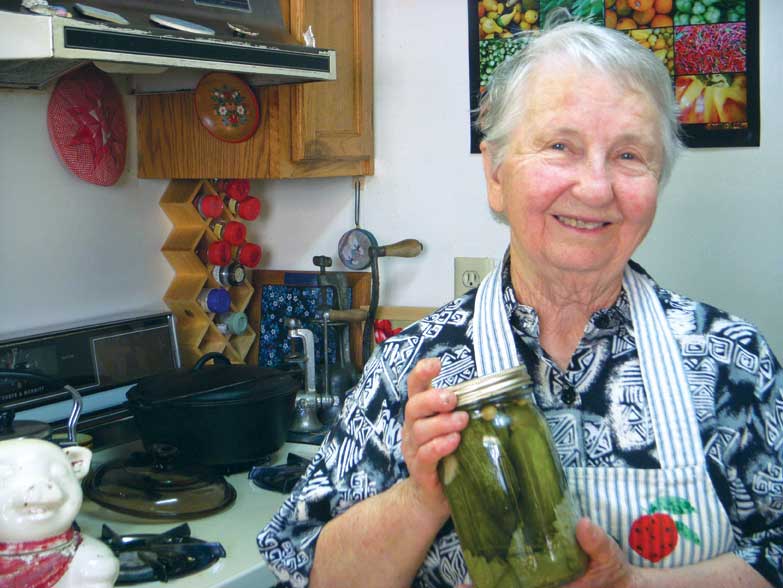
Pickling helps with conserving, digestion, and sustaining vitamins sensitive to oxidation. According to my grandma, famous in Yuba-Sutter 4-H for her pickles, it’s important to make them.

“It perks up a meal. It adds a certain something,” she said.

Grandma’s homemade dill pickles raise quite the pretty penny each year at the 4-H auction.

Originally, my grandma received the recipe from Mrs. Carter, my mom and aunts’ piano teacher. Grandma has been making pickles from this recipe for about 50 years, so while my family may still call them “Mrs. Carter’s pickles,” to me, they’re a special connection to my grandma. I learned to pickle in her kitchen when I was 10. The process is a bit more comfortable than making jam because it doesn’t make the house as hot, and who needs any help with heat in the middle of the summer? I learned the art of packing cucumbers in jars, and believe me, it is an art. It’s like Tetris with cucumbers. There’s a certain satisfaction gained from completing rows of perfectly packed jars, awaiting their fermentation into a blissfully flavorful pickle.

Grandma’s Dill Pickles

Makes 5-6 quarts.

Boil 9 cups of water to 1 cup salt to make brine. Cool.

In each jar, place two grape leaves in the bottom. Put in a branch of fresh dill, 12-14 inches long, folded up. Pack in cucumbers – small ones tend to have the best flavor. Then put in 1 teaspoon of mustard seed, ½ teaspoon alum, 1 piece of horseradish root 1 inch long and ½ inch in diameter, 1 clove garlic (more if you’re a garlic lover), and ½ cup vinegar.

Fill the jars to the top with brine and seal.

Pickles will be ready in three weeks, but are even better in five or more. Pickles are best if eaten within a year.

Symbiotic Sustenance

I’ve been captivated with the way fermented foods make me feel for quite some time. If my digestion gets a little wonky, all I have to do is add a bit of raw, fermented sauerkraut to dinner, and I’m back to 100 percent.

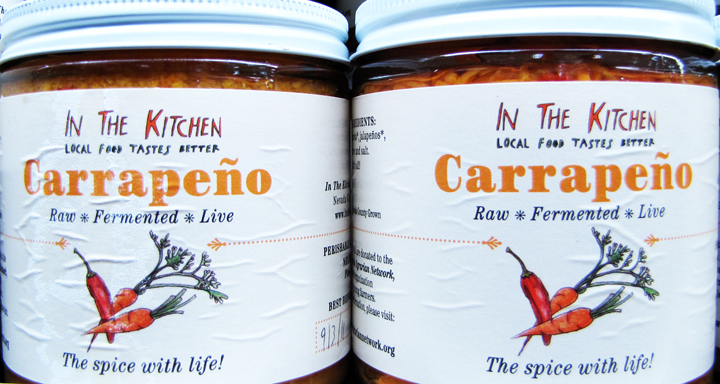
My favorite sauerkraut is from In The Kitchen in Nevada City, a locally-owned business that creates fermented foods as well as hosting cooking classes and small events in their immaculate, certified kitchen. I love their old fashioned, German-style sauerkraut. It’s amazing. I’m also a tad obsessed with their Carrapeño — it’s fantastic on Southeast Asian sandwiches.

Fermented foods really became a big part of my diet after I sat down and chatted with Tim Van Wagner and Joe Meade, two of the three people involved with In The Kitchen’s food line.

Celebrating the cycle of produce, from farm to plate, was the inspiration behind In The Kitchen’s fermented line of foods.

Joe Meade, Wendy Van Wagner, and Wendy’s brother Tim Van Wagner, banded together to create healthy, fermented foods including sauerkraut, Kimchi, dill pickles, and more.

“You grow all of this beautiful food, and then how do you preserve that?” wondered Meade. “Can we make a product for this community that was grown here, made here?”

They did research, planned plots on the farm specifically for cabbage, sourced regional jars and labels, designed the labels, and acquired permits. After the long administrative process was completed, they began selling the product in June, 2010.

“From the start, we weren’t doing this to make money – it’s about advocacy and awareness,” explained Meade. “It’s about the local food movement. Someone had to take the risk, and we feel really blessed that it was us.”

They are really proud that they are able to pay the farmers close to market value for produce. There’s security in that guaranteed sale as well as being assured that they’re getting paid the same as they would if they were selling at a farmers market.

Five percent of the money made goes back to Living Lands Agrarian Network – the group of which Van Wagner is a part. What enables them to do so much is that they have access to both produce as well as a certified kitchen. When they’re not creating fermented foods, In The Kitchen is used for cooking classes and events.

“If we didn’t have the production facility, we probably wouldn’t be able to do it,” explained Meade.

And they find it fun – even when confronted by a mountain of cabbage after a work day, they still enjoy the process. It’s a family project that’s made easier because of the close relationships they have with one another.

“It’s fulfilling,” said Tim Van Wagner.

“It’s fun,” added Meade.

Making a healthy product for the community doesn’t hurt either. Meade and Van Wagner explained that every culture has a fermented food – sauerkraut, kefirs, many fermented drinks, yogurt, etc.

“The pH that is generated is a pretty powerful preservative,” said Meade.

“The bacteria that spoil food can’t exist in that environment,” said Van Wagner.

He explained that our digestion is dependent upon certain bacteria. The lactobacilli that is found in fermented foods helps to break down nutrients for absorption.

“There is really something for me that has a real balance affect … you can literally feel it in your body,” explained Meade.

“It definitely strengthens your immune system,” added Van Wagner.

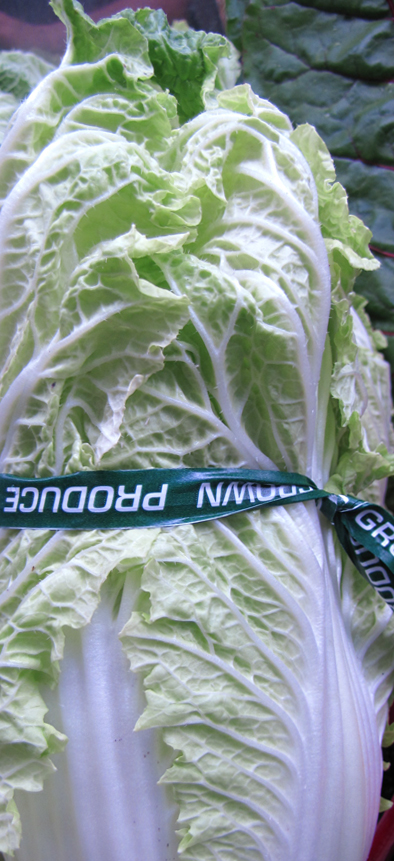
Currently, In The Kitchen produces two sauerkrauts, an original and a German style with juniper berries and caraway; dill pickles; Kimchi made of daikon radish, Napa cabbage, ginger, and red jalapeños; and their signature creation developed by Tim Van Wagner, Carrapeño, a fermented hot relish made of carrots supplied by Leo Chapman, jalapeños, and sea salt.

They said the Carrapeño was the perfect complement to any number of dishes because of the heat and intensity of the jalapeño, the sweetness and earthiness of the carrots, and the tartness from the lacto fermentation. Meade is even using the brine in recipes in which you’d traditionally use ingredients like apple cider vinegar.

In The Kitchen’s fermented foods can be found at natural food stores in the Grass Valley area including BriarPatch Co-op, Natural Selection, California Organics, Natural Valley, and Mother Truckers.
Greens and Prosciutto

It’s the season of greens. Our local farms are growing a very diverse variety,  and confronted by so many beautiful choices in the produce department, I opted to make a meal of them.

Greens and Prosciutto Atop Pumpkin Gnocchi

extra virgin olive oil
1 package prosciutto
1 bunch dandelion greens, coarsely chopped, stems removed
1 bunch red chard, coarsely chopped, stems removed
1 bunch dino kale, coarsely chopped, stems removed
3 cloves of garlic, chopped
1 TB pine nuts
1 package pre-made gnocchi (I used a pumpkin gnocchi found in the refrigerated section of the grocery store.)
grated Parmesan for garnish

Fill a large pot with water and set to boil.

Add enough extra virgin olive oil to coat the bottom of a large skillet. Warm up over medium heat. Add prosciutto and cook until golden brown.

Add all of the greens and stir until everything is coated in oil and prosciutto has been turned to the top. Add garlic and cover, cooking about five minutes or until greens are wilted. Remove cover and stir in pine nuts.

Meanwhile, throw gnocchi into the boiling water. Cook to package directions. Drain.

Layer greens over gnocchi on a plate and garnish with Parmesan. We paired dinner with a wonderful Pinot Grigio.

Peachy Keen Sandwich

Oh, summer! While I’m not a fan of the intense heat, I am a very definite fan of the sweet flavors that the heat produces. Peaches are an obvious example of the glories of hot temperatures. Tomatoes are another.

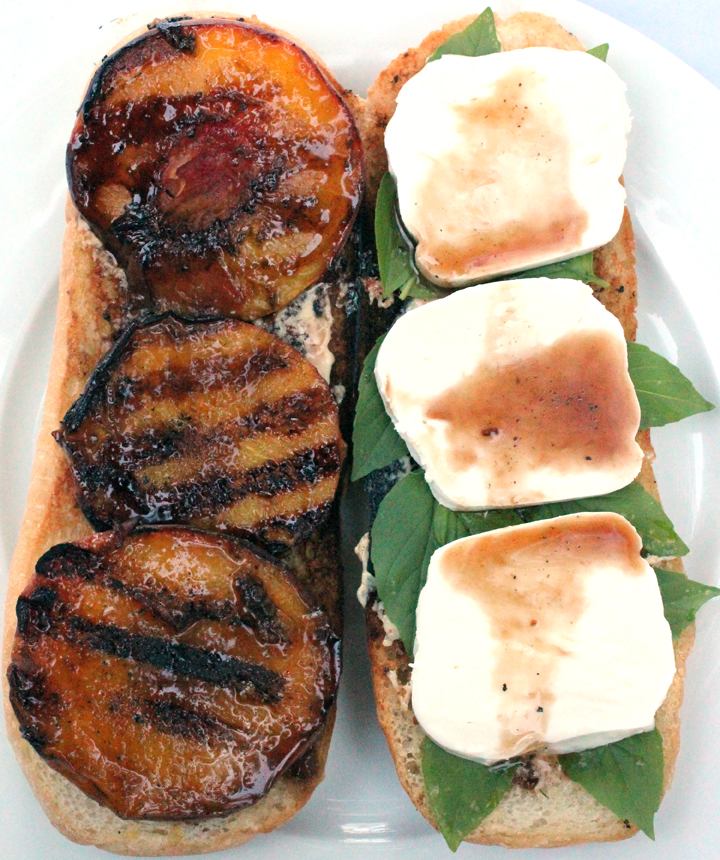
When the mercury rises, I tend to get on caprese sandwich kicks, and I’ve made quite a few already this season. To change things up a bit, I decided to grill some peaches as a substitute for tomatoes. The result was heavenly.

I have a few of notes about this sandwich. One is that I always use a griddle when preparing my bread. Creating a toasted garlic bread brings me back to nights spent at my grandma and grandpa’s house. Grandma would make me garlic bread, toasted face-down on the griddle as a just-before-bed snack. The second is that I mistakenly purchased a tarter sauce jar when I meant to pick up mayonnaise. It was quite the happy accident, as a thin smear of the sauce has brought my sandwiches to a new level of flavor. And of course, if you don’t have a griddle/grill reversible pan, griddle the bread in a regular pan, and if you have a real grill, enjoy the outdoors while cooking those peaches.

Grilled Peach, Basil, and Mozzarella Sandwich

One peach, sliced

Two sprigs lemon basil, leaves removed from stem

sandwich roll

sliced mozzarella

drizzle of fig balsamic vinegar

tarter sauce with jalapeno and horseradish

tsp butter

garlic powder, salt, and pepper to taste

Warm up grill side of grill pan on medium-high heat. Place peach slices on grill. Drizzle with vinegar and sprinkle with salt and pepper. After two minutes, turn over slices and repeat process. After two more minutes, remove from grill and set on a plate to cool.

Scrub down grill and flip to griddle side. Warm griddle on medium-low heat.

Cut roll in half. Butter each half and dust with garlic powder. Place halves butter-side-down on griddle and heat until golden. Remove from heat.

Spread sauce thinly over each slice of bread. On one half, add the basil leaves and sliced mozzarella. On the other half, add the grilled peaches. Drizzle leftover peach and vinegar liquid that has pooled on the plate over mozzarella. Fold halves together and enjoy with a sparkling moscato.


Poached Eggs and Dill Sauce

While chatting with a customer on my work Facebook page this week, the conversation struck upon the topic of my favorite condiment of all time — Larrupin’ Mustard Dill Sauce.

Having lived in Humboldt County for a decade, this splendid sauce was almost taken for granted. When I — sadly — moved away, bringing it back into our lives was of utmost importance. Luckily, my Charles is the Grocery, Wine & Beer Manager of the store, so when he found a vendor, in it came. Our pantry hasn’t been without it since.

Anyway, this lovely customer Melinda, said that she makes an altered Eggs Benedict with the sauce. It was my dinner the last two nights, and it couldn’t be easier.

Saucy Dill Benedict

2 eggs

1 English Muffin

lox

butter

Larrupin’ Mustard Dill Sauce

Poach the eggs to desired consistency. I like a runny yolk.

While eggs poach, toast the muffin. Spread butter on the toasted bread.

Cover the muffin with lox, whatever thickness you choose. Slide the poached egg on top. Drizzle with a healthy amount of Dill Sauce.

I love Larrupin’ Sauce on salmon. Before going on my Benedict bender, I had drizzled it on a small filet that I had grilled, and it was, of course, terrific.

Citrus-y Tempeh

When the warm weather hits, stir-fry reigns supreme. It doesn’t overheat the house, it’s light on the palate and light in the belly.

While looking for ways to cook up a quick tempeh for dinner, I stumbled across 101 Cookbooks and read her wonderful description of Orange Pan-glazed Tempeh. I had to try it, and of course, I tweaked it a tad.

Her version called for maple syrup as a sweetener, but I found that created too much sweetness when coupled with the flavors of the tempeh and the wild rice with kale that I made for the dish’s foundation. The original also called for cilantro leaves to garnish the top. I’d recommend that. I didn’t end up doing it, as I chose to use the last bit from my garden inside the dish and didn’t have any left for garnish. (My cilantro has now bolted, which means it’s time to dig it up and plant some kale.)

Here’s my altered recipe:

1 cup orange juice (Since citrus isn’t in season, I used a high quality, pre-made juice)
1 tablespoon freshly grated ginger
2 teaspoons tamari
1 1/2 tablespoons mirin
1 tablespoon chopped cilantro
3 garlic cloves, chopped
6 ounces of tempeh
1 tablespoon olive oil

Warm up a large skillet over medium heat.
Put the orange juice in a small bowl. Add the ginger, tamari, mirin, cilantro, and garlic. Mix together and set aside.
Cut the tempeh into small pieces.
Drizzle olive oil in skillet. Add the tempeh and sautee until golden. Pour the orange juice mixture into the pan and simmer for 10 minutes, or until the sauce has reduced to a thick glaze.  Stir once or twice while cooking to allow tempeh to absorb as much citrusy flavor as possible.
Serve the tempeh with the sauce.

Just Peachy

It’s peach season, when the payoff for hot days is the sweetness of the fuzzy fruit. As I walked into work today, I could smell the peaches in the produce department from across the store, telling me that it’s time to make jam.

My favorite creation from last year was Peach Vanilla Bean Jam. It was an interpretation of a recipe from the National Center for Home Food Preservation and another from Smells Like Home. I’ll include the recipe for my jam as well as including the measurements for a smaller batch.

Peach Vanilla Bean Jam
Makes 18 pints (or 4+ pints)

15 pounds peaches, blanched, skinned, and pitted (3 pounds)

1 ¼ cups lemon juice (1/4 cup)

2 packages Pomona’s Universal Pectin (1/2 package)

6 vanilla beans, cut open (1-2 beans)

20 cups evaporated cane sugar (4 cups)

Sterilize jars in boiling water, 10 minutes for sea level. Add a minute for every 1,000 feet above sea level. For instance, we live at 3600 Ft., so I sterilized the jars for 14 minutes.

Place peaches in a food processor and mix until peaches are crushed or crush by hand.  Put crushed peaches in a very large pot, add lemon juice and pectin, and stir well. Place on high heat, stirring constantly. Bring to a full boil. Add vanilla pods. Add sugar and heat again to a full boil, stirring constantly. Cook for one minute more, remove from heat, skim if needed, remove vanilla pods, and spoon jam into hot jars using a ladle and wide mouth funnel. Leave ¼ inch of headspace.

Screw on both pieces of the lid and process in a boiling water canner. Process for five minutes at sea level to 1,000 Ft., ten minutes for 1,001 to 6,000 Ft., and 15 minutes above 6,000 Ft.

Remove jars using a pair of canning tongs. Place jars on a towel on the counter and let sit until cool. As jam cools, the sound of the lids sealing will occur, and it sounds so cool!

This jam is a dream for anyone with a sweet tooth. It’s amazing on vanilla ice cream as well as on English muffins, pancakes, or anywhere else you can imagine jam hanging out. It’s also pretty awesome spooned straight from the jar. This creation was also the most popular Christmas gift I’ve ever given out. After doling out jars to friends and family, we were lucky that we had one left for us.

The Cycle of the Hamburger

I’m half town mouse and half country mouse. My mom loves her creature comforts – full-service cable, air conditioning, and oodles of places to eat out on a whim. My dad grew up on a dairy farm, getting in scrapes, being a buddy with dirt, and being happiest sans roof.

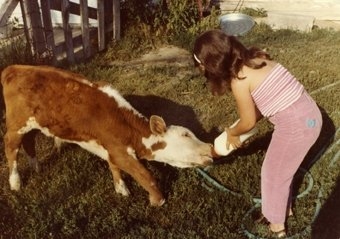
Mellisa bottle-feeding a calf

Me, and the calf I saved from a ditch, a long time ago.

By the time I came into the picture, my paternal grandparents had shifted from dairy cows to beef, Polled Herefords to be exact, and moved to Montana. My brother, sister, and I spent many a summer day up at their ranch, getting into our own scrapes, helping where we could, and learning the all-important lesson of farm to table.

I was really lucky to get these experiences. To look at me, you’d think I’m all town mouse. In fact, whenever playing, “To Tell the Truth,” my story about herding cattle always gets chosen because, well, no one looks at me and thinks, “Well golly, of COURSE she’s herded cattle.” Part of my luck, I feel, is that I was exposed to the whole circle of life and have a pretty priceless understanding of how a calf that I rescued from a ditch would someday end up as hamburger, and I was okay with that.

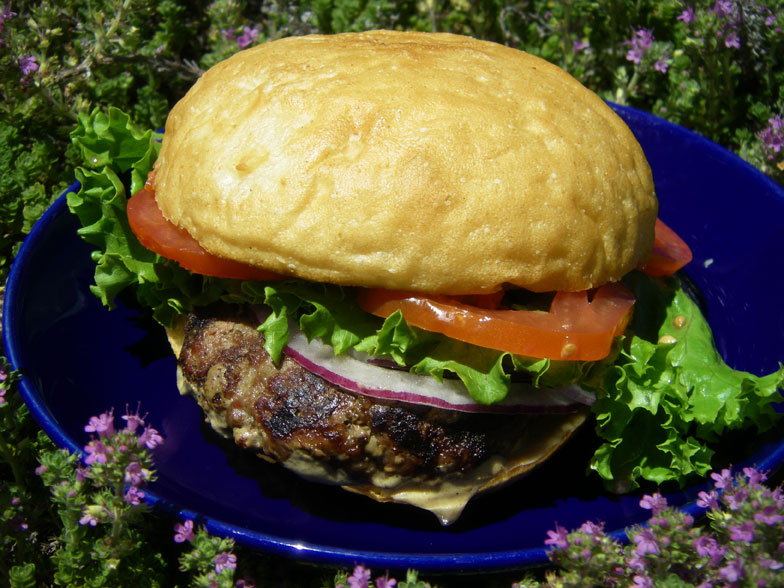
Understanding breeds acceptance. When I became a vegetarian, my beef-raising family accepted that change with nary a blink. When I returned to eating meat a few years later because of my health,  that too was accepted. While I never came back to the place where I ate as much meat as I had before going veggie, I gotta say, a good grass-fed, grass-finished steak or hamburger is a lovely thing to experience.

Locally, we’re gifted with a wonderful beef rancher by the name of Jim Gates. His beef tastes as good as it gets – lean, juicy, and chock full of flavor. Jim is something of a rock star around these parts. Mister Salt-of-the-Earth, brusque rancher-man is like a palette-cleanse – he tells it like it is, with an impish sense of humor.

Celebrating Scapes

One of the things I thoroughly enjoy about the local produce season getting under way is the challenge of the hunt. Since I discovered garlic scapes a couple of years ago, I eagerly anticipate their addition to the produce shelves. They’re only around for a short time, so the scapes have to be celebrated and savored while they’re here.

My favorite recipe for garlic scapes is from Dorie Greenspan’s blog. It’s a lovely, vibrant pesto made with scapes, parmesan, and almonds.

I toss the pesto with some al dente fettuccine, sprinkled some extra parmesan on top, and Kablam – it’s a taste sensation. The intense flavors of garlic and greenness dance upon the taste buds in a very pleasing samba.  We love pairing the pasta with a Viognier. The garlic amazingness brings out pear flavors in the wine that are lovely counterpoints, while the acidity helps the wine hold its own against the strength of the garlic.

One of our local bread bakers is also using scapes right now, in an amazing creation she calls “Armenian Spring Bread.” It’s quite tasty on its own and is an awesome side to pasta.

In Heaven there are Cherry Trees

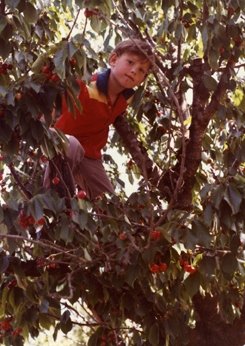
My brother, many, many years ago.

In Heaven, there are cherry trees.

I know this. There just have to be. Every summer afternoon spent up in my grandma’s cherry tree was a little bit of Heaven. The still, dusty, oppressive heat of the Sacramento Valley would retreat under the shade of the old, wizened tree. I’d scramble up the trunk and sit on my favorite branch, kicking my legs with their perpetually skinned knees as I gathered a bucket’s worth of cherries and consumed another bucket’s worth.

That first taste of a summer-ripe cherry brings me back to those long-gone June afternoons. For the moments that I’m savoring that sweet, plump fruit, I’m a kid again – sitting high in a tree and having pit-spitting contests with my brother and sister. Cherries are one of the reasons that I love June. Though the month may blindside you with a few triple digit days, it always makes up for it in the sweetness of its fruit.

Pork Chops with Brandied Cherry Sauce

Serves: 4

15 ounces of cherries

2 rounded spoonfuls sugar

4 large, boneless center-cut pork chops

Salt and pepper

2 tablespoons extra-virgin olive oil

1 large shallot, finely chopped

Splash of brandy

1/2 cup chicken stock, preferably from your own freezer

2 tablespoons butter

3 tablespoons fresh mint leaves, finely chopped


Preheat oven to 375 degrees F.

Put cherries in a small bowl with the sugar.

Heat a skillet with an oven safe handle over medium high to high heat.

Season chops with salt and pepper. Add 1 tablespoon extra-virgin olive oil to a hot skillet. Place chops in skillet and sear meat on both sides to caramelize the chops. Place a loose tin foil tent over the pan and transfer the chops to oven to finish off, 7 or 8 minutes, until meat is firm to touch, but not tough.

Remove meat from oven and transfer to dinner plates. Cover chops with foil to keep warm. Place chop skillet back on stove over medium heat. Add a tablespoon extra-virgin olive oil, 1 turn of the pan. Add shallots and sauté 1 to 2 minutes. Add cherries and warm through. Add brandy, then add stock. Reduce stock a minute, then add butter in small pieces. Toss sauce to combine and sprinkle in mint. Pour sauce down over chops.

Adapted from a Rachael Ray recipe

  • Recent Posts

  • Archives

  • Categories

  • Meta