Eating Winchester

Avebury

The skies were dreary and overcast. My wool pea coat was a must and was destined to be drenched multiple times. A pub and a pint by a crackling fire beckoned, but I was on a gastronomic mission – to eat at as many great restaurants in Winchester as possible.

We were visiting my sister, a recent Masters graduate from the Winchester School of Art. People had made fun of our culinary pursuits while in England – don’t they boil everything? – but we persevered and were rewarded with a week’s worth of wonderful meals. Winchester is actually a hub of a town with a teeming culture.

To begin our eatery extravaganza, we did in fact choose a pub. We were in England after all! At the Royal Oak, I opted for the Fish & Chips, and I was not disappointed. The haddock had wonderful flavor, the batter light and crunchy. The serving was huge – too much to consume in one sitting. The only unfortunate aspect was that it was presented on a wooden tray that had obviously been abused with frequent washing. (I was also not a fan of mushy peas, sorry!)

Trying Indian food was a must. I grew up in Yuba City (it’s often referred to as “Little India” because of the large Sikh population), which means that I also grew up with Indian cuisine, and I was curious to experience the differences – if any – from across the pond. The waiter didn’t believe that I could handle the spice in my meal, I ordered madras, but I could have handled more. We shared some lovely garlic naan and a bottle of Riesling for a very satisfying meal.

At Rimjhim, we waited – and waited – for the bill. We had encountered the lovely, non-pushy restaurant culture in Great Britain. They’ll let you sit there for hours if you don’t tell them you’d like the bill that last time the waiter or waitress stops by and asks if you’d like anything else. (When we ended up wanting dessert at another place after our meal, we had to practically pounce on a member of the staff in order to procure our bill.) After being left alone for what seemed like an eternity, we finally walked up to the register.

With traditional pub food and Indian out of the way, the next stop on our culinary journey was, of course, Italian. Zizzi was a bit haughty, and they sat our riffraff selves in a corner behind a life-sized statue of a horse, but my Ravioli Di Capra was divine, and the Barbera De Asti Superiore 2010 D.O.C.G., Chiarlo Piemonte was quite lovely with the food. It did sport more than a touch of Brett, to which I’m very sensitive (I think it tastes like Band-Aids), so it wasn’t my favorite, though that Brettanomyces, along with its restrained mineral characteristics, made it very European.

On our last day, we kept it Mediterranean and headed to Spain. El Sabio had a wonderful assortment of tapas. My choice of three dishes, Croquetas De Setas y Queso de Cabrales, Ensalada Mixta, and Albóndigas en Salsa de Tomate were perfect and packed with flavor. We shared a bottle of Tempranillo, Marqués de Verdellano for a very easy-going, and very filling, lunch.

I think our favorite stop of all was The Black Bottle – not a restaurant, though they do offer food, but rather a wine bar. With a card that had been charged from money given at the register, you could choose wine by the glass in 125 ml, 175 ml, or taste sizes. I had a grand time skipping around and sampling various wines from the automated dispensers until I happened upon my favorite, Masseria Pietrosa Malvasia Nera, and had a glass. I love it and am hoping to find a distributor here in the States. Thank goodness I live with a wine buyer!

All in all, our gastronomic tour of Winchester was a rousing success. We had a wonderful experience, and with all of the walking we did, I managed not to gain any weight, so, WIN!

Blue Diamond

photo from Blue Diamond

photo from Blue Diamond

In spring, California’s valley is blanketed in a glory of orchards in bloom. Soft, white petals flutter overhead and cover the ground, turning it downy and fragrant.

That promise of almonds is an integral part of springtime in the valley, but where do those almonds end up once they’ve matured?

One destination is a grower-owned co-op, Blue Diamond Growers headquartered in Sacramento. Blue Diamond has been in the business of almonds for 102 years and has become the world’s largest tree nut processing and marketing company. As well as marketing to all 50 states, the business also sells to many other countries and is the sixth largest U.S. food export.

Blue Diamond has been groundbreaking in many areas, calling themselves the “first name in almonds.” They were the first grower-owned cooperative for marketing almonds, the first to develop a market for California almonds in over 90 countries, and much more.

In 1909, an almond grower from the Lodi area named, J. P. Dargitz, first promoted a concept of a statewide almond marketing association. The next year, nine grower groups formed the California Almond Growers Exchange (CAGE). In 1911, a branded consumer package was proposed, and the Blue Diamond consumer business was born. The grower-owned co-op continued to flourish throughout the 20th century.

In 2000, Blue Diamond’s nut line was expanded when MacFarms, a macadamia producer from Hawaii, was purchased. 2010 found California almond crops averaging 1.5 billion pounds – double what they had been a decade ago and 80 percent of the world’s almond supply. The supply barely kept up with the world’s demand. Blue Diamond expanded its range of products, sending almonds past peanuts as the world’s top ingredient nut.

As the health benefits of almonds continue to be discovered – the Los Angeles Times stated that almonds are a good source of vitamin E, protein, fiber, and magnesium as well having been found to contribute to heart health – Blue Diamond continues to grow. It’s a co-op that has found its success in the almond orchards of California.

Drunk Ruby Turkey

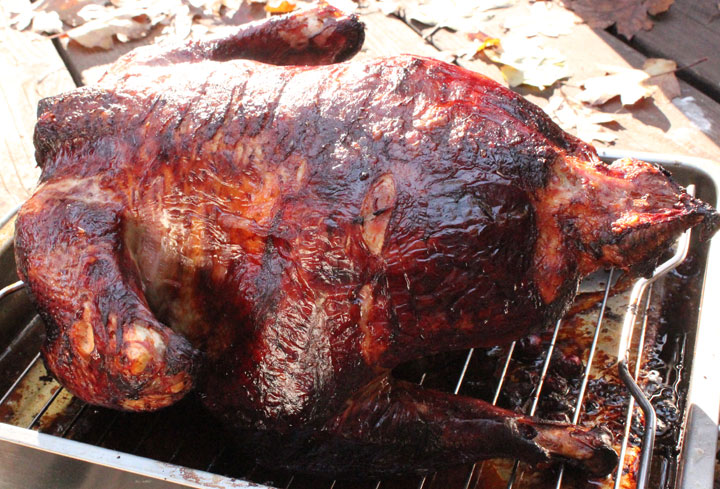
I’ve been a brining convert for the last few years. I find that it helps deal with a few of the oopses that can occur when cooking a very large bird. Brining fills the meat with flavor, no worries about missing a spot when seasoning. It helps keep the turkey moist and juicy — even if you leave it in the oven a tad too long. It helps make the skin crispy, too, as you don’t need to worry about baking bags and the like. Plus, you can kiss that baster goodbye because there’s still plenty of the juices left in the bird — you don’t have to continuously drizzle them back on. All that said, I do like to mix up the recipe each year so that the turkey on the Thanksgiving table keeps people oohing and ahhing. For 2012, I used a brine with lots of red ingredients, making for one beautifully roasted bird.

Drunk Ruby Turkey

1 turkey
4 cups (32 oz) cranberry juice
2 bottles red wine (I used a good quality boxed wine so I had extra, just in case.)
zest and juice from 4 oranges
zest and juice from 4 lemons
2 cups cranberries
4 stalks lemongrass, chopped
1/2 cup fresh ginger, grated
1/2 cup fresh mint, chopped (I ended up using a dried bunch that I had hung this summer.)
5 Tbsp. whole, mixed peppercorns
2 Tbsp. kosher salt

At least 8 hours before serving, place all ingredients in a stock pot that is large enough to hold the turkey and liquid. Cover and refrigerate.
When ready to cook, preheat oven to 400°.
Pour brining liquid through a sieve. Discard liquid and put solids in turkey cavity.
Place turkey, breast side up, in a large pan with a metal cooling rack set inside, and cook until meat thermometer reads 165 degrees F. Turn the bird over 1 hour in so that juices drain into the breast and the entire turkey gets crispy.
Let the turkey rest on the counter for 20 to 30 minutes before carving.

Cranberry Chutney

Cranberries are as much a part of a traditional Thanksgiving feast as turkey. While there is no evidence that cranberries were served at the very first Thanksgiving, they were a part of the Native American diet and soon became a staple in the new colonists’ diet as well. “By the late eighteenth century an average midday colonial meal included cranberries in some form — mostly sauced,” stated Lynn Kerrigan on globalgourmet.com.

The round, red fruit is still an important part of the American diet today. Besides being added to toothsome muffins and breads, many people use the juice as a preventative for urinary tract problems, and there is some evidence of antioxidant qualities. The American Cranberry is grown mostly in Wisconsin, but it is also farmed in Massachusetts, and to a lesser extent in New Jersey, Oregon, and Washington.

For many, their expectation of cranberries as a side dish comes from the sauce or jelly in cans. While this is indeed easy, it isn’t what I expect. My mom took a gourmet cooking class in the mid 70s and completely changed our family’s feelings on the ruby sauce. Instead, each year a lovely, multi-flavored relish is presented on our thankful Thursday table.

The recipe my mom learned in that class is below, with a little added tip just from her.

CRANBERRY CHUTNEY
1    pound cranberries
1    c granulated sugar
½    c packed brown sugar
½    c golden raisins
1½   t ground cinnamon
½    t ground ginger
½    t ground cloves
¼    t ground allspice
1    c water
1    c chopped onion
1    c chopped cored pared baking apple
½    c chopped celery

Simmer cranberries, sugars, raisins, spices and 1 cup water uncovered in 1-quart saucepan over medium heat, stirring frequently, until juice is released from berries, about 15 minutes.  Reduce heat; stir in remaining ingredients. Simmer uncovered until thick, about 15 minutes.  Refrigerate covered up to 2 weeks.

One pound frozen cranberries can be substituted for fresh.

(I throw everything into the pot together and simmer until really thick. Sometimes that takes 30-45 minutes.)

The Positive Diet

When looking at diet, it’s easy to focus on the negatives – limit caffeine, avoid sugar, keep away from food sensitivities, but there is so much good to focus on.

Have you ever had one of those meals where you felt energized after you finished eating? That’s something healthy food can do. There’s no reason to feel lethargic and drained after eating when – with a few, healthy decisions – you can instead feel like you can conquer the world.

Fresh fruits and vegetables are important. More and more research shows just how important they can be. In fact, the USDA recommends that half of your plate be filled with fruits and vegetables at every meal.

According to a recent Harvard University Medical Center and Norwich Medical School study, eating citrus may reduce a woman’s risk of stroke. Antioxidants found in fresh produce fight inflammation. Nutritionist Marion Nestle has stated that fiber, which occurs only in plants, helps protect against obesity, heart disease, Type 2 diabetes and even some cancers. Yet, most Americans only consume half of the fiber they should each day. She goes on to say that people who eat plenty of vegetables, fruits, and whole grains develop less chronic disease.

Besides feeling better on the inside, fresh food can also help lighten your mood. Walking into a produce department is a feast for all of the senses. Let the wide variety of colors wash over you. Even the various, variegated greens can be a joy. Savor the sweet smells of the strawberries and mangoes, the earthy aroma of mushrooms, the green sharpness of garlic scapes, and the pungent zip of onions and garlic.

These are experiences everyone can enjoy, even with diet restrictions like gluten-intolerance or diabetes. Each of us should be eating more vegetables, no matter our diets, and choosing new varieties to try can be a culinary adventure.

Julia Child said, “Moderation. Small helpings. Sample a little bit of everything. These are the secrets of happiness and good health.” No matter what your diet restrictions may be, keep this in mind as you fashion your meals. Focus on healthy fruits and vegetables. Love your diet, no matter what. The abundance of tasty, wholesome food around you is a blessing that can bring you satisfaction, and hopefully make you feel really good, too.

*originally ran in the Northern Gold Country Parents’ Resource Guide

Pesticides in Food

Pesticides – they’re everywhere. From the weed killer sprayed on lawns to the insecticides sprayed on conventional produce, the exposure can be extreme.

According to The Organic Center Critical Issue Report, “The average child in America is exposed to 10 to 13 pesticides daily in their food and drinking water.” Another study from The Environmental Working Group found that an average of 200 industrial chemicals and pollutants were found in the umbilical cord blood of 10 babies born in the U.S. in 2004, and a Mercer Island Children’s Study found that the urine and saliva of 21 school-age children tested positive for insecticide residues.

Though these studies are concerning, there are positive things that can be done. Both the Mercer Island and the Organic Center studies found that once children switched to an organic diet, within fewer than five days, no residue was detected. Dr. Alex Lu of the Mercer study found that, “the transformation is extremely rapid … Once you switch from conventional food to organic, the pesticides … in the urine disappear.”

There are many things you can do to benefit of your child’s diet. Even if you cannot afford to go entirely organic, there are some foods to make sure to avoid. The top ten conventional produce with the most pesticide residue is peaches, apples, bell peppers, celery, nectarines, strawberries, cherries, kale, lettuce, and imported grapes.

Even though rinsing helps, it does not eliminate pesticides. Peeling is pretty effective, but then you lose nutrients found in the skin. To avoid as many pesticides as possible, eat a varied diet, rinse all produce, and buy organic when you can.

Remember – it’s never too late to change your eating habits. Even if you’ve only eaten conventional produce, don’t give up hope for a healthier diet. It’s an organic apple away.

Healthy School Lunches

While Jamie Oliver may have brought the issues with school lunches into the American consciousness, parents can be in even more control of their children’s lunches by packing those boxes themselves.

Children who eat a healthy diet have been found to concentrate more and perform better in school. A nutritious lunch is one in which fiber, carbohydrates, proteins, and fats are all represented. Even though incorporating vegetables into meals can be the most challenging aspect, integrating them into something like a tuna salad sandwich with finely chopped red peppers can be quite successful.

Keep sandwiches appealing by using different breads, like pitas, tortillas, and foccacia. Instead of using processed lunch meats, use leftover chicken. Keep things interesting by sending hot soup or a cold fruit smoothie in a thermos one day and then thinly sliced veggies with hummus for dipping the next. Keep it simple by focusing on the three main requirements for a packed lunch – a main dish, a vegetable, and something sweet (like yogurt or fruit). Keep it fun by focusing on the cute factor – cut sandwiches into fourths, make pin wheel wraps, slice up an apple and rub it with lemon juice to keep it from browning, or use skewers (with rounded edges) for meats, cheeses, and veggies. Economize by creating your own trail mix that your child can snack on at their midmorning break. Remember that a lot of extra calories are consumed in drinks, so focus on water or milk. If your child still wants the occasional juice box, make sure it’s 100% juice, and stay away from soda and punch.

A good rule of thumb for healthy lunch box ideas is to consider what your grandmother, or even your great-grandmother, would have packed for her children. Steer clear of processed foods and high-sugar snacks. With a little bit of planning, preparation, and creativity, your children can have lunches that will be interesting, fun, and most importantly, nourishing.

Nika the Breadnik

There are few things homier than the smell of baking bread. Nika Franchi, also known as Breadnik, seems to carry a whiff of fresh bread around her like a peaceful aura.

“There’s something very nurturing and something very mothering about working with dough,” Franchi said.

That care and attention comes out in her work. Her bread became an instant hit at BriarPatch, but she wasn’t always a baker. Her professional life began as a classically trained musician. After that, she was a globetrotting translator.

“Four years ago, I didn’t know anything – the word yeast would throw me into a panic,” she laughed.

One day, she decided to try her hand at bread making. The first attempt was successful, as was a second, and then she failed. Franchi didn’t let that failure stop her. She kept working at it until she figured out the process and was happy with her creations.

Soon after, fate stepped in. She brought a loaf of her bread to her local farmers market in Ohio to give to a friend. The friend didn’t meet her, so Franchi decided to leave it with the market manager. The manager tried it and wanted more, and Breadnik was born.

When the economy turned south, Franchi became a full time bread baker, selling 150 loaves a week as well as selling soups and preserved foods.

As popular as her bread was in Ohio, her Nevada County friends said, “We want you here.” Originally from Moscow, Russia, Franchi had lived in many places, but Nevada County was home. She, her husband, and her youngest daughter decided to pack up their equipment and move. They now live outside of Grass Valley.

Currently, Breadnik produces around 150 loaves a week. All of the recipes are Franchi’s creations, based on the memories of breads consumed during vacations in Italy. The business is expanding sustainably, though that requires her to work a baker’s schedule – six days a week. “I’m always either mixing or baking,” she said.

Living locally and sustainably is one of Franchi’s main focuses. She’s working with local farmers and selling to the local markets. She’s also using available ingredients to create a bread of the month as well as her staple loaves, including the low gluten Russian Coriander Rye.

“With my bread, I reflect the … seasons,” she explained. “It’s a lot more meaningful to do something that’s local. It’s a lot better for my soul, too.”

More information on Breadnik can be found at her blog, her Facebook page, or by calling (530) 913-9673.

Freezing Meals

When planning meals in advance, your freezer becomes your best friend. Foods like casseroles, lasagnas, and soups can be prepared ahead of time, frozen, and then moved to the refrigerator the night before the dish will be reheated.

When prepping foods for the freezer, where do you start? Airtight seals are a must in order to prevent freezer burn. Casserole dishes that come with seal-able lids are a good choice as well as containers with lids that can be pushed down to squeeze out the extra air. Freezer bags are also a great option – just make sure to empty it of as much air as possible before sealing.

Don’t feel limited to dinner foods when planning meals. Cooked pancakes freeze nicely and are a snap to reheat. Cook home style potatoes or hash browns and freeze them for a quick side dish for breakfast or even brinner – breakfast for dinner.

When getting soup ready to be set back, cook, then let cool. Pour into airtight containers, leaving an inch or so for expansion. To prevent freezer burn, place a sheet of plastic wrap on top of the soup before putting on the lid.

Meat freezes wonderfully as does bread and rice. When contemplating fruits and vegetables for freezer habitation, think about the water content. If they’re watery, like melons, lettuce, or cucumbers, they probably won’t freeze well. Other types of produce will soften, so it’s best to use them in cooked foods or smoothies.

Speaking of smoothies, those brown bananas that usually go to the compost heap make wonderful drinks. Cut them into slices and freeze in bags. They’re a great base for other fruits, juice, and yogurt, and they’ll make your smoothie smoother and sweeter without needing to add anything extra, like honey.

Organizing foods by preparing them ahead of time will save you last minute trips to the grocery store as well as meal time stress. A little planning and freezer prep will help make your kitchen a peaceful oasis.

Quick freezer use-by dates for quality:
•    Bread – use within a month.
•    Fruits and Vegetables – three to six months
•    Soups – three to six months
•    Casseroles – use within a month

Freezer Tomato Sauce

1/2 cup extra-virgin olive oil
1 small organic yellow onion, finely chopped
3 organic garlic cloves, finely chopped
2 tsp sea salt
1/2 tsp freshly ground black pepper
2 tsp red pepper flakes
2 tsp dried oregano
2 dried bay leaves
5 leaves fresh organic basil, chiffonade or torn
2 (32-ounce) cans or about 15 fresh and blanched, organic crushed roma tomatoes
Additional salt & pepper to taste
1/2 to 3/4 cup chicken or vegetable stock

In large heavy pot, heat the olive oil over medium-high heat. Add the onion. Sauté for about 5 minutes, or until the onion is slightly translucent. Add the garlic, salt, and pepper and sauté another 3 to 5 minutes or until the onion is translucent and the veggies are tender, being careful not to brown the garlic.

Add in the tomatoes, bay leaves, basil, oregano, and red pepper flakes. Simmer, uncovered, over a low heat until the sauce thickens, about 1 to 2 hours, checking the seasonings occasionally. When the sauce has thickened, remove from heat and let cool slightly. Remove the bay leaves. Working in batches, puree the sauce in a food processor or blender until smooth.
Pour into airtight containers and freeze for up to one month or refrigerate for up to one week.

When ready to use:
Allow the sauce to defrost overnight in the refrigerator. Put sauce in a large pot over medium heat. Add the stock to thin the sauce out to the desired consistency. Taste and add more salt and pepper if necessary. Heat through and serve with your favorite pasta.

Beets

I may not enjoy the taste, but beets sure are pretty.

  • Recent Posts

  • Archives

  • Categories

  • Meta