Equal Exchange

A taste of what will be in the next BriarPatch Vine Newsletter:

Cooperative and Fair Trade are integrally mixed in the philosophy of Equal Exchange.

A worker-owned co-op, Equal Exchange is on the forefront of fighting to keep Fair Trade Certification dedicated to the living-wage of small farmers, not the boon of plantations. The company feels that Fair Trade USA has diluted the original intent of the certification to extend to large scale plantations.

“In the developing world, co-op production is focused on the 99 percent. Plantations are the one percent,” said Rodney North, worker-owner, former board director, and The Answer Man at Equal Exchange.

“Fair Trade and farmer co-ops are an opportunity to shift the economic power back to the community,” he said.

While their current battle is to keep Fair Trade for small farmers, it has always been a founding principle. Equal Exchange helped introduce Fair Trade coffees to grocery stores in the United States and was the first U.S. company to use Fair Trade Certified sugar as an ingredient as well as to offer it as a stand-alone product.

They also have a direct relationship with the farmer co-ops from whom they buy their coffee, tea, cocoa, chocolate, olive oil, California almonds, and bananas. In fact, everyone that is employed by Equal Exchange gets to visit a farmer co-op.

“It’s very powerful,” said Kevin Hollender, retail representative from Equal Exchange.

“It brings what we’re doing home.”

Kevin also said that the direct relationship helps when times are tough, when things need to be addressed, like the threat from Fair Trade USA. Then, not only can the worker co-op organize, so too can the farmer co-ops.

The value of fairness to farmers and dedication to that practice, as well as building a closer connection with them, was the motivating vision of Equal Exchange’s founders.

Rink Dickinson, Jonathan Rosenthal, and Michael Rozyne met while working in management at a food co-op in New England. They wanted to transform the relationship between food producers and the public, change the food world.

Twenty years later, Equal Exchange is the world’s largest worker-owned coffee roaster, a $50 million enterprise. They employ 120 full-time people, 103 of whom are members. Employees must work one year before they become eligible to join. They’ve won WorldBlu’s World’s Most Democratic Workplace a few times and won “Best Support of the Fair Trade Movement” this year.

“From an unlikely beginning, we’ve now grown into a sizable organization,” said Rodney.
Grandma’s Pickles

Summertime means loads of cucumbers. One vine can produce oodles of cukes, more than it seems possible to eat. What do you do with all of the lovely, left-over bounty from your garden? You pickle, of course.

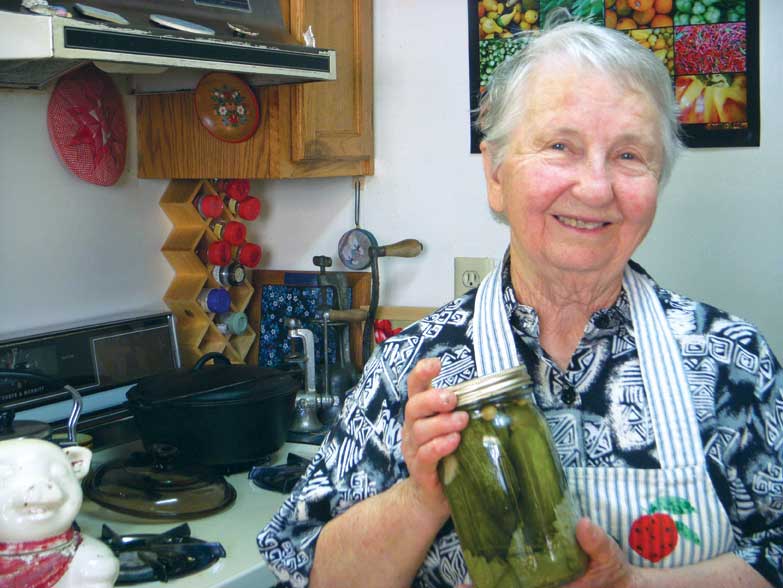
Pickling helps with conserving, digestion, and sustaining vitamins sensitive to oxidation. According to my grandma, famous in Yuba-Sutter 4-H for her pickles, it’s important to make them.

“It perks up a meal. It adds a certain something,” she said.

Grandma’s homemade dill pickles raise quite the pretty penny each year at the 4-H auction.

Originally, my grandma received the recipe from Mrs. Carter, my mom and aunts’ piano teacher. Grandma has been making pickles from this recipe for about 50 years, so while my family may still call them “Mrs. Carter’s pickles,” to me, they’re a special connection to my grandma. I learned to pickle in her kitchen when I was 10. The process is a bit more comfortable than making jam because it doesn’t make the house as hot, and who needs any help with heat in the middle of the summer? I learned the art of packing cucumbers in jars, and believe me, it is an art. It’s like Tetris with cucumbers. There’s a certain satisfaction gained from completing rows of perfectly packed jars, awaiting their fermentation into a blissfully flavorful pickle.

Grandma’s Dill Pickles

Makes 5-6 quarts.

Boil 9 cups of water to 1 cup salt to make brine. Cool.

In each jar, place two grape leaves in the bottom. Put in a branch of fresh dill, 12-14 inches long, folded up. Pack in cucumbers – small ones tend to have the best flavor. Then put in 1 teaspoon of mustard seed, ½ teaspoon alum, 1 piece of horseradish root 1 inch long and ½ inch in diameter, 1 clove garlic (more if you’re a garlic lover), and ½ cup vinegar.

Fill the jars to the top with brine and seal.

Pickles will be ready in three weeks, but are even better in five or more. Pickles are best if eaten within a year.

Symbiotic Sustenance

I’ve been captivated with the way fermented foods make me feel for quite some time. If my digestion gets a little wonky, all I have to do is add a bit of raw, fermented sauerkraut to dinner, and I’m back to 100 percent.

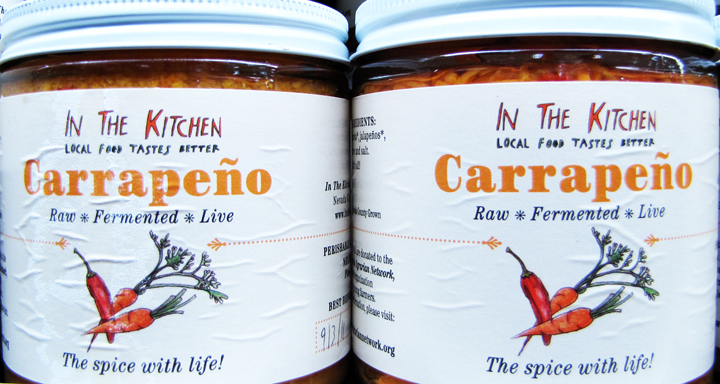
My favorite sauerkraut is from In The Kitchen in Nevada City, a locally-owned business that creates fermented foods as well as hosting cooking classes and small events in their immaculate, certified kitchen. I love their old fashioned, German-style sauerkraut. It’s amazing. I’m also a tad obsessed with their Carrapeño — it’s fantastic on Southeast Asian sandwiches.

Fermented foods really became a big part of my diet after I sat down and chatted with Tim Van Wagner and Joe Meade, two of the three people involved with In The Kitchen’s food line.

Celebrating the cycle of produce, from farm to plate, was the inspiration behind In The Kitchen’s fermented line of foods.

Joe Meade, Wendy Van Wagner, and Wendy’s brother Tim Van Wagner, banded together to create healthy, fermented foods including sauerkraut, Kimchi, dill pickles, and more.

“You grow all of this beautiful food, and then how do you preserve that?” wondered Meade. “Can we make a product for this community that was grown here, made here?”

They did research, planned plots on the farm specifically for cabbage, sourced regional jars and labels, designed the labels, and acquired permits. After the long administrative process was completed, they began selling the product in June, 2010.

“From the start, we weren’t doing this to make money – it’s about advocacy and awareness,” explained Meade. “It’s about the local food movement. Someone had to take the risk, and we feel really blessed that it was us.”

They are really proud that they are able to pay the farmers close to market value for produce. There’s security in that guaranteed sale as well as being assured that they’re getting paid the same as they would if they were selling at a farmers market.

Five percent of the money made goes back to Living Lands Agrarian Network – the group of which Van Wagner is a part. What enables them to do so much is that they have access to both produce as well as a certified kitchen. When they’re not creating fermented foods, In The Kitchen is used for cooking classes and events.

“If we didn’t have the production facility, we probably wouldn’t be able to do it,” explained Meade.

And they find it fun – even when confronted by a mountain of cabbage after a work day, they still enjoy the process. It’s a family project that’s made easier because of the close relationships they have with one another.

“It’s fulfilling,” said Tim Van Wagner.

“It’s fun,” added Meade.

Making a healthy product for the community doesn’t hurt either. Meade and Van Wagner explained that every culture has a fermented food – sauerkraut, kefirs, many fermented drinks, yogurt, etc.

“The pH that is generated is a pretty powerful preservative,” said Meade.

“The bacteria that spoil food can’t exist in that environment,” said Van Wagner.

He explained that our digestion is dependent upon certain bacteria. The lactobacilli that is found in fermented foods helps to break down nutrients for absorption.

“There is really something for me that has a real balance affect … you can literally feel it in your body,” explained Meade.

“It definitely strengthens your immune system,” added Van Wagner.

Currently, In The Kitchen produces two sauerkrauts, an original and a German style with juniper berries and caraway; dill pickles; Kimchi made of daikon radish, Napa cabbage, ginger, and red jalapeños; and their signature creation developed by Tim Van Wagner, Carrapeño, a fermented hot relish made of carrots supplied by Leo Chapman, jalapeños, and sea salt.

They said the Carrapeño was the perfect complement to any number of dishes because of the heat and intensity of the jalapeño, the sweetness and earthiness of the carrots, and the tartness from the lacto fermentation. Meade is even using the brine in recipes in which you’d traditionally use ingredients like apple cider vinegar.

In The Kitchen’s fermented foods can be found at natural food stores in the Grass Valley area including BriarPatch Co-op, Natural Selection, California Organics, Natural Valley, and Mother Truckers.

  • Recent Posts

  • Archives

  • Categories

  • Meta