 There’s something so fulfilling about making chicken stock. I feel so good about not wasting anything, and then I have a freezer full of additions to my cooking.
I enjoy the whole process, too. Since I work full time, I do the majority of my cooking in the evenings. I’ll bake the chicken one night, let it rest, slice off a couple of pieces for dinner, and then cover it and place it in the refrigerator.
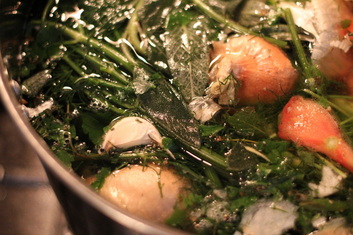
The next evening, I do what is so elegantly called, “picking the carcass.” Any of the usable meat is kept for sandwiches, salads, etc. The bones, skin, and other various bits gets thrown in a large stock pot along with whatever extra veggies are sitting around.
Now, there are die hard you-must-do-it-this-way-and-none-other stock makers out in the world. I feel making stock is about economizing, so I don’t buy extra ingredients for something that costs me nothing but extra time.
My grandma taught me that wasting food was a Cardinal sin – and really, why do it? That said, there were always some things that found their way into the compost bucket instead of our bellies, and it bothered me. Then I realized that there wasn’t any reason to compost all the onion ends, extra celery stalks, the going-woody carrots, past-its-prime garlic, and meat trimmings. If I kept them until I had enough for stock, there would be practically no waste.
In these days of using everything and saving as many pennies as possible, keeping a corner of my freezer reserved for unused produce just makes sense. I now have a couple of one gallon, glass jars with screw on lids into which I throw all of my extra produce pieces. Once I’ve baked a chicken and have the carcass ready for simmering, I throw everything from those two jars into the stock pot along with the chicken.
Everything simmers slowly for hours. As foam gathers on the surface, it gets skimmed off, and after the concoction has reduced by about half, I turn off the flame and let it cool. Then the big pieces get removed with a slotted spoon. What’s left gets strained until just the clear stock remains. The stock gets poured into canning jars with a bit of air left at the top and are placed in the freezer for whenever they’re needed. It’s rare for me to not have stock in the house.
Finishing this task always leaves me feeling warm, fuzzy, and accomplished. Wouldn’t it be nice if everything was like that?


 Sapid Cellar Door